
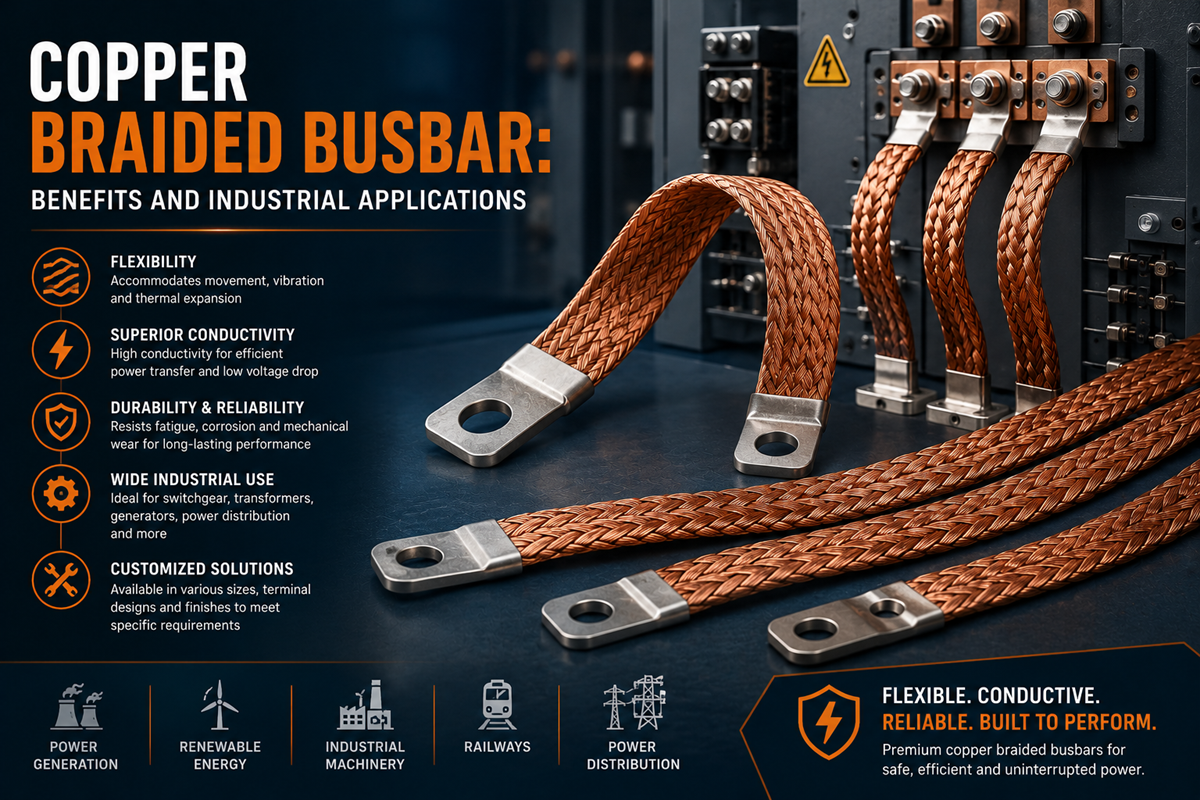
Copper Braided Busbar: Benefits and Industrial Applications
The copper braided busbar has become an essential component in modern electrical systems due to its flexibility, high conductivity, and ability to handle heavy current loads. Industries that require reliable power distribution increasingly prefer copper braided busbars over rigid conductors.
A copper braided busbar consists of multiple layers of braided copper conductors designed to provide efficient electrical connectivity while accommodating movement, vibration, and thermal expansion. These flexible connectors are widely used in switchgear, transformers, power distribution systems, generators, and industrial machinery.
One of the major advantages of copper braided busbars is flexibility. Traditional rigid busbars can experience stress due to vibration or expansion and contraction caused by temperature changes. Copper braided busbars absorb these movements, reducing mechanical stress and improving system reliability.
Another important benefit is superior conductivity. Manufactured using high-quality electrolytic copper, braided busbars offer excellent current-carrying capacity with minimal voltage drop. This helps improve energy efficiency while reducing heat generation in electrical systems.
Copper braided busbars are also known for their durability. Their braided construction enhances resistance to fatigue and mechanical wear, making them ideal for applications where continuous movement or vibration occurs. Industries such as power generation, renewable energy, railways, and heavy engineering rely on these connectors to ensure uninterrupted electrical performance.
In switchgear and power distribution systems, copper braided busbars serve as flexible connections between conductors and equipment. They help prevent damage caused by thermal expansion while maintaining consistent electrical contact. Many manufacturers also offer tinned or silver-plated options to improve corrosion resistance and performance in harsh environments.
Another advantage is customization. Copper braided busbars can be manufactured in various widths, thicknesses, lengths, and current ratings to suit specific application requirements. This flexibility allows engineers to design efficient and reliable electrical systems tailored to their operational needs.
When selecting a copper braided busbar, factors such as current capacity, operating environment, flexibility requirements, and terminal design should be considered. Choosing a trusted manufacturer ensures high-quality materials and precision engineering for long-term performance.
Conclusion
A copper braided busbar offers the perfect combination of flexibility, conductivity, and durability. Its ability to handle heavy electrical loads while accommodating movement makes it an ideal solution for modern industrial and power distribution applications. By investing in premium-quality braided busbars, businesses can improve electrical efficiency, reliability, and operational safety.
