
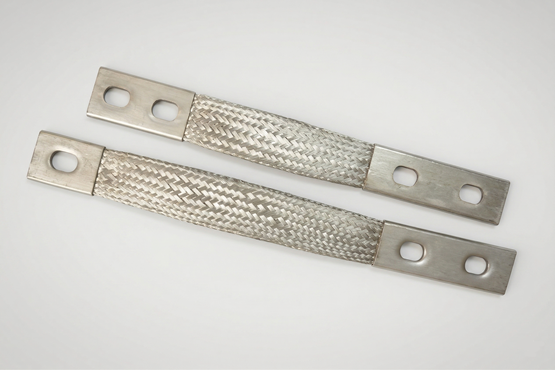
Copper Flexible Shunts are designed to provide efficient electrical connectivity in applications requiring flexibility, high conductivity, and reliable performance. Manufactured from high-conductivity electrolytic copper, our copper flexible shunts are engineered to withstand vibration, thermal expansion, and continuous current flow. Available in various sizes and configurations, each copper flexible connector is manufactured to meet diverse industrial requirements while ensuring excellent electrical performance and durability.
Terminal ends can be deep riveted or solder dipped to increase the contact area, resulting in lower resistance and enhanced current carrying capacity.
Indico manufactures copper flexible shunts by stacking multiple foils of high-conductivity electrolytic copper (0.035 mm to 0.3 mm thick) and bonding them through a high-current, high-pressure diffusion welding process. This advanced technique creates a homogeneous molecular bond without filler metals, ensuring minimal voltage drop, low temperature rise, and superior electrical conductivity.
The finished copper flexible connector maintains a uniform cross-section throughout its length while offering excellent flexibility for applications involving movement, vibration, and thermal expansion. Contact areas can also be drilled, milled, or machined to meet specific installation requirements without affecting electrical performance.
Our copper flexible shunts are widely used in electrical and industrial systems that require reliable power transfer along with mechanical flexibility.
Their flexible construction helps absorb vibration and expansion while maintaining uninterrupted electrical conductivity.
Choosing the right copper flexible connector ensures long-lasting performance and reliable electrical connections in demanding industrial environments.
A copper flexible shunt is an electrical connector manufactured from multiple layers of electrolytic copper foils. It is designed to provide efficient current transfer while accommodating vibration, movement, and thermal expansion in electrical systems.
Copper flexible shunts are commonly used in switchgear, transformers, electrical control panels, power distribution systems, industrial machinery, resistance welding equipment, and other high-current electrical applications.
Copper flexible shunts offer high electrical conductivity, low resistance, improved flexibility, excellent current carrying capacity, reduced heat generation, and a longer service life, making them suitable for demanding industrial environments.
Yes. Copper flexible shunts can be manufactured in custom sizes, thicknesses, lengths, widths, hole patterns, and terminal configurations to meet specific application requirements.
High-conductivity electrolytic copper provides excellent electrical performance, low power loss, and improved durability. It enables copper flexible shunts to deliver efficient current transfer while maintaining flexibility under continuous operation.
The flexible laminated construction helps reduce stress caused by vibration and thermal expansion while maintaining a stable electrical connection. This improves system reliability, minimizes resistance, and enhances the overall performance of electrical equipment.

Your action has been completed successfully.
